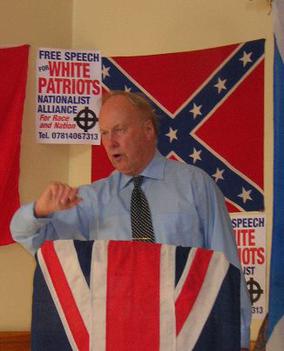
John Tyndall's Legacy: Shaping Britain's Far-Right Movements
The landscape of political ideology is often shaped by figures whose impact, though controversial, leaves an indelible mark. In the context of Britain's post-war extremism, few individuals have been as central to the development and articulation of far right activist thought as John Tyndall. From his early engagement with fringe nationalist groups to his founding and leadership of pivotal organizations like the National Front (NF) and the British National Party (BNP), Tyndall meticulously crafted an ideology of racial nationalism that continues to echo within segments of the contemporary far-right. Understanding his journey, beliefs, and methods offers crucial insight into the historical roots and persistent appeal of extremist movements in the UK.
The Formative Years: From Post-War Britain to Radical Awakening
Born John Hutchyns Tyndall in Exeter, Devon, in 1934, his early life unfolded against a backdrop of significant national change. His family, with Irish-Protestant roots on his father's side, soon relocated to south London, placing young Tyndall amidst the urban challenges and patriotic fervour of World War II. While he left no detailed memoirs of specific wartime events, the collective experience of aerial bombings, rationing, and national mobilization undoubtedly fostered a sense of communal resilience and, perhaps, a growing disillusionment with perceived national vulnerabilities in the post-war era. These formative years coincided with the decline of the British Empire and a period of austerity, factors that often fuel a search for national identity and perceived strength.
Tyndall attended Beckenham and Penge Grammar School but departed at age 15 in 1949, entering clerical employment with the Civil Service. His academic path was not distinguished enough to secure entry into military academies like Sandhurst, a personal disappointment that may have influenced his later quest for order and strong leadership. During this period, he engaged in self-directed learning through evening classes in accountancy and business studies. Interestingly, his political awakening saw a brief flirtation with socialist ideas before a decisive pivot towards nationalist texts. This shift marked the beginning of his transformation into a dedicated far right activist. His early affiliations, starting with the League of Empire Loyalists in the 1950s and culminating in his co-founding of the British National Socialist Movement in 1962, clearly indicated a hardening of his ideological stance towards an overt emphasis on racial separation and nationalistic purity.
Architect of British Nationalism: From National Front to BNP
Tyndall's political career was characterized by a relentless drive to organize and promote his nationalist vision. His leadership of the National Front (NF) from 1972 to 1980 marked a significant, albeit ultimately limited, period of growth for the British far-right. Under his guidance, the NF managed to achieve notable electoral results, including garnering over 200,000 votes (0.6% of the national total) in the 1979 general election. While seemingly small, this represented a peak for the far-right in Britain at the time and demonstrated Tyndall's capacity to mobilize and articulate a coherent, if extremist, message to a segment of the electorate. His strategies involved leveraging anxieties around immigration, unemployment, and social change, positioning the NF as a radical alternative.
Following internal disputes within the NF, Tyndall founded the British National Party (BNP) in 1982, serving as its chairman until 1999. The BNP under Tyndall continued to push a hardline nationalist agenda. He was not just an organizer but also a prolific propagandist. He edited the monthly *Spearhead* magazine, which reportedly circulated up to 15,000 copies, disseminating his views to a dedicated readership. His semi-autobiographical work, *The Eleventh Hour: A Call for British Rebirth* (1988), became a foundational text for many British nationalists, outlining his vision for national renewal through policies like the repatriation of non-white populations and staunch opposition to multiculturalism. These publications were crucial in solidifying his status as a leading far right activist and ideologue.
The Core Ideology: Repatriation, Race, and Reshaping Britain
At the heart of John Tyndall's philosophy was an unwavering commitment to racial nationalism and a belief in the inherent superiority of the white British population. His ideology centered on several key tenets:
- Racial Separation: Tyndall advocated for a racially segregated society, believing that different races could not coexist harmoniously within a single nation. This was a cornerstone of his vision for 'British rebirth'.
- Repatriation of Non-White Populations: A central policy proposal in *The Eleventh Hour* and throughout his campaigning was the compulsory repatriation of non-white immigrants and their descendants. This extreme measure was presented as the only way to restore Britain's perceived racial and cultural homogeneity.
- Opposition to Multiculturalism: Tyndall vehemently rejected the concept of multiculturalism, viewing it as a threat to British identity and social cohesion. He argued that it led to the fragmentation of society and diluted the nation's core values.
- Strong State and National Identity: He championed a powerful, centralized state that would enforce his nationalist agenda, prioritising national interests above all else, and fostering a singular, exclusive British identity.
These ideas, while abhorrent to the vast majority, resonated with a vocal minority who felt disenfranchised or anxious about societal changes. Tyndall was adept at framing complex social issues through a simplistic, racially charged lens. His persistent advocacy for these views often brought him into direct conflict with the law. He faced numerous legal repercussions, including convictions under the Public Order Act in 1962 for paramilitary activities, in 1966 for possessing offensive weapons, and in 1986 for incitement to racial hatred. His life ended shortly before a scheduled court appearance on similar charges in 2005, a testament to his lifelong, controversial commitment to his extremist beliefs.
Tyndall's Enduring Shadow: Legacy in Modern Far-Right Movements
While John Tyndall's political parties ultimately declined in direct influence, his foundational work as a far right activist cast a long shadow over subsequent British nationalist movements. The themes he championed—concerns about immigration, the erosion of national identity, and skepticism of multiculturalism—continue to resurface in various forms, often adapted to new social and political contexts. Tyndall's role was not just about leading parties; it was about building an ideological framework and providing a historical lineage for those who followed.
In the contemporary landscape, while the overt national socialist rhetoric of Tyndall's early career might be less prevalent in mainstream discourse, the core anxieties he exploited persist. Modern figures like Tommy Robinson Protests: Inside British Far-Right Activism, for instance, operate in a different media environment, leveraging digital platforms and targeting specific issues like Islam or perceived government failures. However, the underlying currents of 'us vs. them', appeals to national pride, and a rejection of perceived societal 'otherness' bear a conceptual resemblance to the narratives Tyndall meticulously constructed decades ago. These contemporary far right activist movements often build upon the groundwork laid by earlier figures, even if they evolve the messaging and tactics.
Furthermore, the ongoing debate around national sovereignty and border control, as seen in instances like the UK Bars Dutch Far-Right Activist: Border Control & Ideology, highlights the state's efforts to manage and prevent the entry of individuals deemed to pose a threat to public order or social cohesion due to their extremist views. This demonstrates a continuous vigilance against ideologies that Tyndall and his contemporaries sought to normalize. The challenge for societies remains how to robustly counter such narratives while upholding democratic freedoms, a complex task that requires understanding the historical trajectory of extremism.
John Tyndall's life as a far right activist was dedicated to propagating a divisive and often hateful ideology that left an undeniable, albeit negative, mark on British political history. His organizational efforts and prolific writings established a significant ideological precedent for post-war British nationalism. While the direct influence of the parties he led waned, the underlying themes and anxieties he articulated have shown a disturbing persistence, evolving into new forms within the modern far-right landscape. Understanding Tyndall's legacy is crucial not only for grasping the historical evolution of extremism in Britain but also for appreciating the ongoing challenge of combating ideologies that seek to divide and undermine democratic values.